
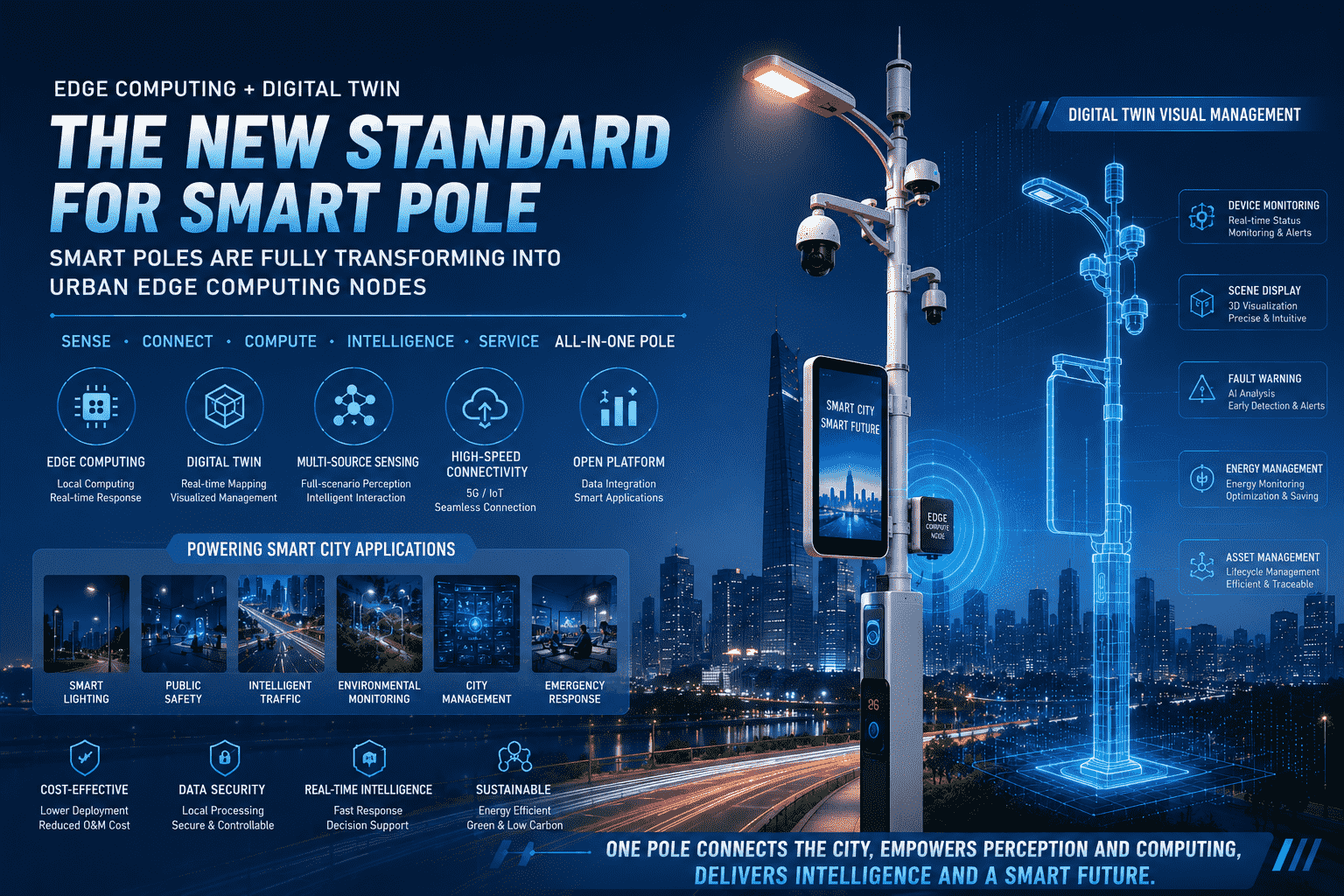
Edge computing + digital twinization become standard features, Street lamps become urban edge computing nodes
Date:2026-05-07

With the acceleration of the implementation of smart cities, vehicle-road collaboration, low-altitude economy, and urban refined governance, traditional smart lamp poles that only perform basic functions such as lighting, monitoring, and WiFi are no longer sufficient to meet the demands. Starting from 2026, edge computing + digital twin will officially become the standard configuration for new and renovated smart lamp poles, and ordinary street lamps will be fully upgraded to urban distributed edge computing nodes.
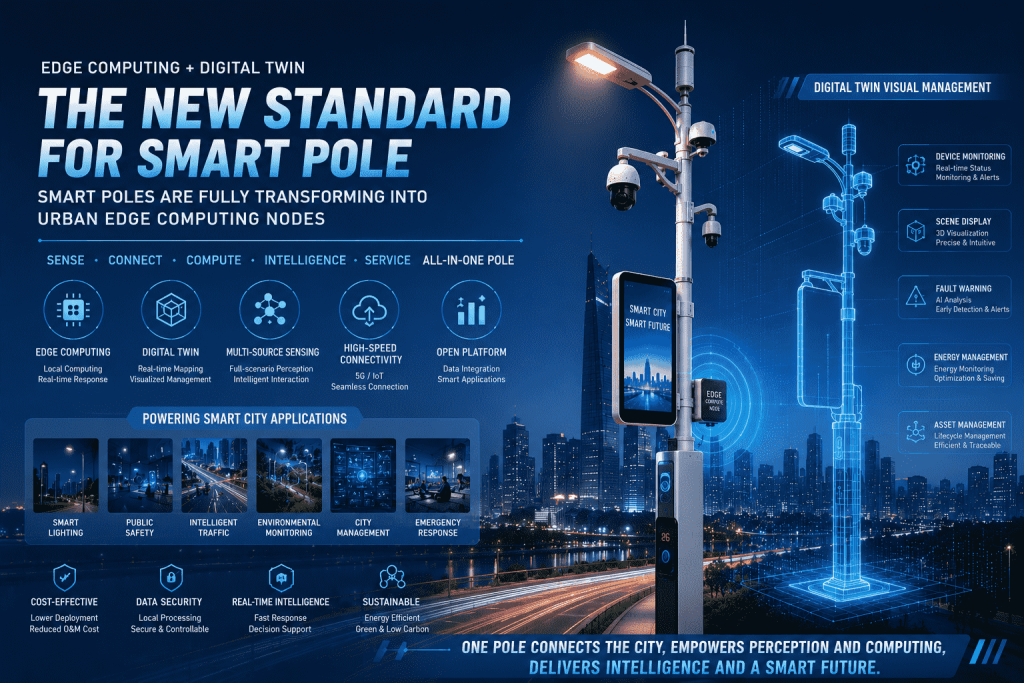
Edge computing + digital twinization become standard features, Street lamps become urban edge computing nodes

1.Real-Time AI Video Analysis

The smart light pole is equipped with an edge gateway to locally process camera footage in real time. Without transmitting data back to the cloud, it can realize: pedestrian and vehicle flow statistics, illegal parking recognition, roadside stall detection, pedestrian fence-climbing identification, and intelligent snapshotting of garbage accumulation. It features low latency and bandwidth savings.

2.Vehicle-Road Collaborative Data Processing

It connects with autonomous driving and smart traffic systems, collecting real-time road conditions, vehicle speeds and traffic signal status. Data preprocessing is completed on the edge side of the light pole, assisting vehicles in perceiving road conditions and providing early warnings to support the urban smart traffic network.
 
3.Centralized Linkage of Multiple Devices
 
It integrates environmental sensors (temperature, humidity, PM2.5, noise and meteorological data), one-click alarm, IP audio speaker, display screen and single-lamp controller. The edge terminal performs unified data collection, local computing and nearby linkage, with automatic fault reporting and instant abnormal early warning.
 

4.Cloud Pressure Reduction

A large number of basic calculations, video analysis and device management are completed locally on the edge side of light poles. Only key data and alarm information are uploaded to the cloud, greatly reducing the load of platform servers and network transmission costs.