
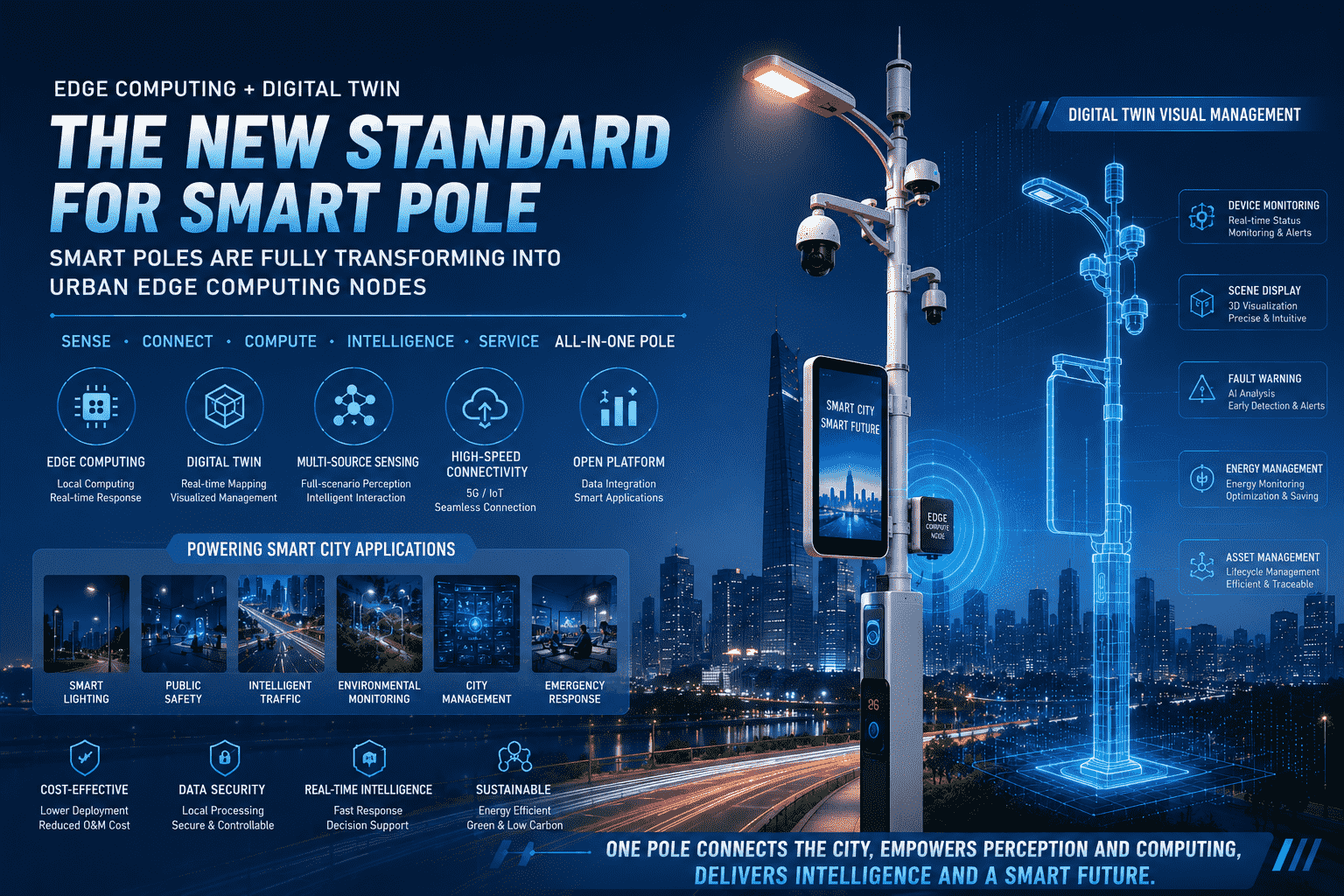
With the acceleration of the implementation of smart cities, vehicle-road collaboration, low-altitude economy, and urban refined governance, traditional smart lamp poles that only perform basic functions such as lighting, monitoring, and WiFi are no longer sufficient to meet the demands. Starting from 2026, edge computing + digital twin will officially become the standard configuration for new and renovated smart lamp poles, and ordinary street lamps will be fully upgraded to urban distributed edge computing nodes.
1.Real-Time AI Video Analysis
The smart light pole is equipped with an edge gateway to locally process camera footage in real time. Without transmitting data back to the cloud, it can realize: pedestrian and vehicle flow statistics, illegal parking recognition, roadside stall detection, pedestrian fence-climbing identification, and intelligent snapshotting of garbage accumulation. It features low latency and bandwidth savings.
2.Vehicle-Road Collaborative Data Processing
4.Cloud Pressure Reduction